
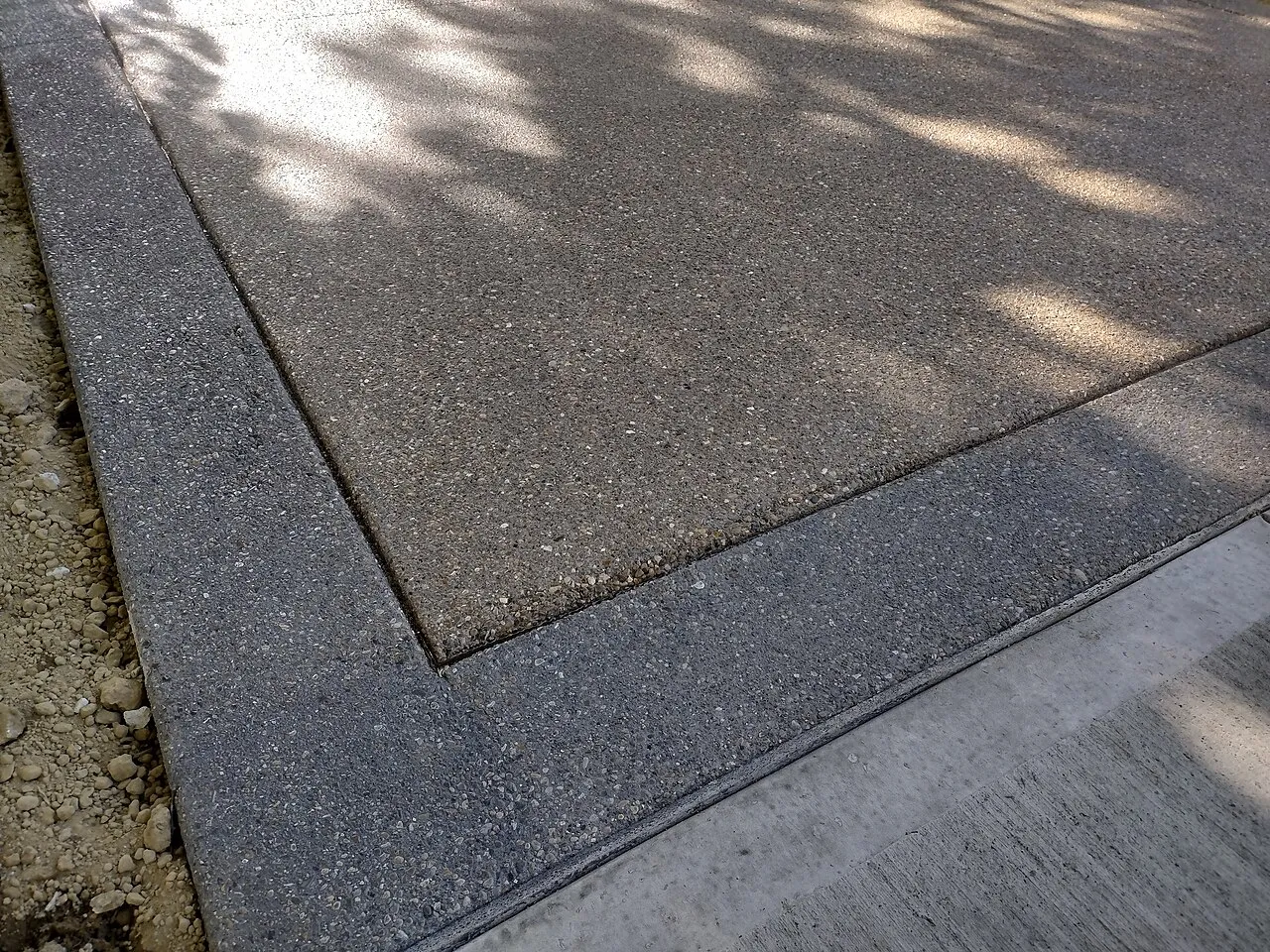

Why sample selection deserves more than a quick glance
Choosing a coloured concrete driveway comes down to more than picking a chip from a brochure. The colour you approve indoors under fluorescent light can look noticeably different once it cures in full Adelaide sun, sits next to your brick fascia and weathers through its first summer. Recording the proposed sample before work gives you and the provider a common reference for discussing the specified finish and its limitations; it does not guarantee the installed appearance.
This guide focuses on the practical process of evaluating coloured concrete samples: when and where to view them, how to read adjoining materials, and how approved product references protect you during the job.
View samples outdoors, at the right time of day
Coloured concrete pigments — whether integral oxide colours or surface-applied stains — respond strongly to natural light. A sample that looks warm terracotta inside can read more orange in direct midday sun and shift towards brown in late afternoon shade. For a coloured concrete driveway Adelaide homeowners should take any physical sample chips or poured test slabs outside and view them:
- In the morning and again in the afternoon on the same day
- In direct sun and in the shade cast by your house
- Against the actual driveway surface (whether existing concrete, gravel or bare ground) rather than a neutral indoor floor
If your contractor provides a small poured or pressed sample panel rather than a chip, place it on the driveway area and photograph it in different conditions. Photographs help you compare options side by side without relying on memory.
Wet vs dry appearance matters too. Fresh concrete and rained-on cured concrete both look darker than dry, cured concrete in ordinary conditions. Ask your contractor to show you a cured dry sample, since that is the state you will see most of the time.
Match samples to adjoining materials, not just personal preference
A driveway does not exist in isolation. The colours and textures already committed to your property — roof tiles, brickwork, rendered walls, fencing, garden edging — either harmonise with or compete against your concrete choice. Before narrowing down sample options, gather swatches or photographs of:
Fixed elements (things you are unlikely to change)
- Roof tile colour and texture
- Face brick or rendered wall colour
- Garage door colour and material
- Boundary fencing material
Variable elements (things that could be adjusted)
- Garden bed edging and feature paving
- Path surfaces connecting to the driveway
- Letterbox or gate materials
A useful exercise is to lay your concrete sample chips next to photographs of these elements on a large white sheet in outdoor light. This is a hypothetical scenario rather than a guaranteed design outcome, but it helps you identify clashes before they are set in concrete. For instance, a mid-grey charcoal concrete can read as blue-grey next to warm-toned clay bricks, whereas the same colour sits neutrally next to grey rendered walls.
If your driveway connects to a path or alfresco area in a different material — exposed aggregate, for example — read our Exposed Aggregate Driveway Selection guide to understand how those textures and tones interact with coloured concrete options.
Understand the difference between colour methods
Not all coloured concrete is the same, and the method used affects how the final colour looks and how it ages. The main approaches a concreter may discuss include:
- Integral pigment — oxide pigment blended into the mix throughout. The colour runs through the full depth of the slab, so surface wear does not reveal a different colour underneath.
- Surface hardener with colour — a dry shake product broadcast over fresh concrete and trowelled in. Can achieve deeper, more even tones but is a surface layer.
- Penetrating stain or sealer — applied after curing. Colour is on and near the surface; reapplication may be needed over time.
Each method produces a sample that ages differently. When reviewing samples, ask which method they represent and how the contractor expects the colour to change over five or more years. This is a question for the contractor to answer based on their product knowledge, not something to assume from a chip alone.
For a broader view of finish types to discuss, see our Concrete Driveway Finish Options guide.
Use approved product references in your quote documentation
Once you have settled on a colour direction, ask the contractor to reference the specific product, manufacturer, colour name and mix ratio in writing — not just a verbal description like “charcoal” or “slate.” The same colour name can vary between product ranges, so a documented reference makes comparisons and later discussions clearer. It does not determine your legal rights or guarantee an exact visual match.
A properly documented quote or contract should include:
- Manufacturer name and product line
- Colour code or name as listed in the manufacturer’s range
- Application method (integral, dry shake, stain)
- Sealer product and sheen level, if applicable
This documentation also matters if the job spans more than one pour date. Concrete batch variation between pours is a known risk; a written product reference helps your contractor and the batching plant minimise it.
If you are comparing quotes, our Concrete Driveway Cost Questions guide explains what else to look for in quote detail before committing.
Council and crossover requirements can affect your material choice
If your driveway includes or modifies a crossover — the section crossing the footpath verge from the road — your colour and material choice may interact with council requirements. In South Australia, councils including Port Adelaide Enfield describe crossover construction and maintenance as an owner responsibility subject to council specifications. The City of Prospect requires authorisation before installing, modifying or relocating a driveway and gutter crossover on public land.
This does not mean councils dictate your driveway’s private surface colour, but it does mean that crossover materials, finishes and stormwater outcomes may be assessed separately from the private driveway area. The Town of Gawler describes stormwater affecting neighbours outside a recent development application as a civil matter between property owners. Council permission for crossover work or a stormwater connection to the street kerb is a separate question.
Check with your specific council before work begins. South Australia’s planning framework operates across multiple assessment pathways depending on the proposal, so what applies in one suburb may differ in another. Verifying requirements with the relevant council or a licensed professional before pouring is straightforward and avoids the cost of changes after the fact.
South Australian consumers can check a builder’s licence status and ask for clarification on contract terms through the SA Government’s guidance on choosing a building professional — something worth doing before engaging any contractor for significant driveway work.
Sealer sheen level is part of the colour decision
The sealer applied over coloured concrete changes the final appearance significantly. A high-gloss sealer deepens and intensifies the base colour; a matte or low-sheen sealer returns something closer to the natural cured tone. Many homeowners are surprised that the same base colour looks quite different depending on sealer choice.
Request that sample panels or chips be shown to you with the intended sealer applied, not just the base concrete. If you are undecided, ask the contractor to demonstrate the same sample with two different sheen levels side by side.
Sealer choice also has practical implications: high-gloss sealers can become slippery when wet and may require a non-slip additive, particularly on driveway slopes. This is a question for your contractor to address based on the specific site gradient and product.
Before you request a quote
Before contacting contractors for a coloured concrete driveway quote, it helps to arrive with:
- A shortlist of two or three colour directions (not just one) so the contractor can give informed input
- Photographs of your home’s fixed elements taken in natural outdoor light
- Notes on any council crossover work that may be involved
- A clear sense of whether you prefer integral colour, surface colour or a stained finish
This preparation makes site visits more productive and quotations easier to compare accurately. When you are ready to explore options, our Concrete Driveway Enquiries page connects you with local contractors, and our Driveway Replacement and Upgrades page covers situations where an existing driveway needs to come up first.
For households also considering asphalt as an alternative surface, the Asphalt Driveway Enquiries page outlines that pathway.
Further reading
Discuss your project
This guide helps prepare questions; it is not a site assessment, design specification or professional approval. Read about concrete driveway enquiries in adelaide before making a project enquiry.