
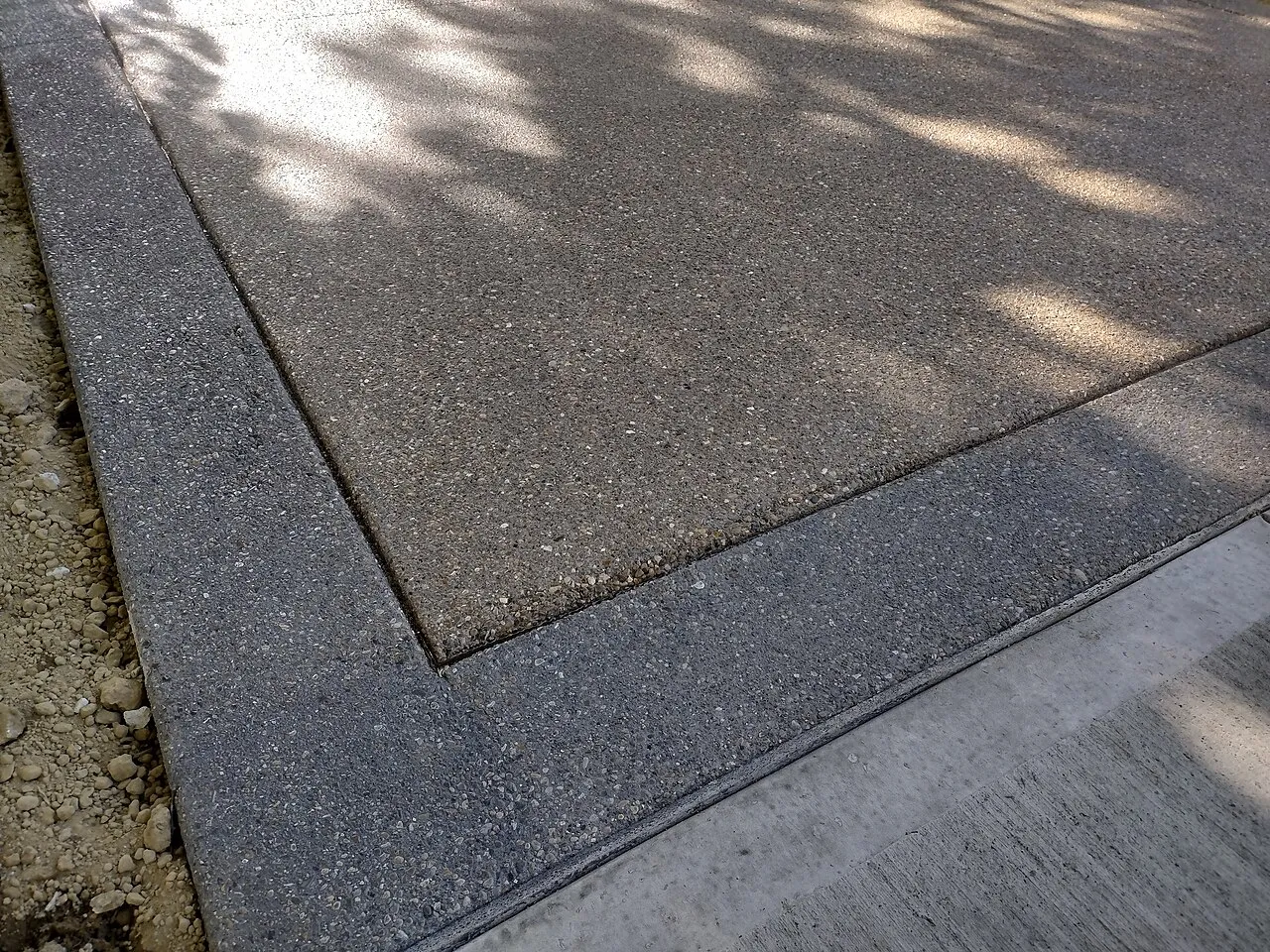

What makes exposed aggregate different from other concrete finishes
An exposed aggregate driveway is poured using standard concrete, but the top layer of cement paste is removed — by washing, brushing or surface retarder — before it fully cures, leaving the decorative stone, pebble or recycled glass aggregate visible on the surface. The result is a textured, non-slip finish with far more visual character than plain grey concrete. Because the colour and texture come from the aggregate itself rather than a surface coating, the appearance is embedded throughout the top layer rather than sitting on top of it, which matters for durability and long-term looks.
If you are weighing up finish options more broadly, the guide to concrete driveway finish options to discuss covers how exposed aggregate compares to broom finish, stencilled, and other alternatives worth raising with a contractor.
Choosing aggregate: what physical samples actually show you
Colour cards and website photos of exposed aggregate concrete are rarely reliable predictors of what the finished driveway will look like at your home. Lighting conditions, the mix ratio of cement to aggregate, the depth of exposure, and the colour of your house’s facade all shift the perceived result significantly.
Ask any contractor you are considering to show you physical samples — either cured concrete boards or existing driveways they have laid nearby. Physical samples reveal:
- Aggregate size: Small pea gravel reads as a fine, relatively uniform texture. Larger river stones create a bolder, more rugged look with deeper shadow lines.
- Colour variation within a mix: Most aggregates are blended from multiple stone colours. A sample shows whether the final result reads as predominantly one tone or as genuinely speckled.
- Exposure depth: Lightly exposed aggregate retains more cement matrix around each stone, giving a smoother feel underfoot. Deeply exposed aggregate is rougher and more visually dramatic.
- Wet versus dry appearance: Sealed aggregate darkens noticeably when wet. If your driveway stays shaded, ask to see a damp sample.
The related guide on coloured concrete sample selection goes into more detail on evaluating concrete colour samples in general, including how to assess a sample under different light conditions.
Layout choices that affect both appearance and function
Beyond the aggregate mix itself, several layout decisions shape the final outcome.
Banding and borders: A contrasting plain concrete or coloured concrete border around a central exposed aggregate field is a popular Adelaide choice. It frames the driveway visually and can simplify construction at the edges where forming is more complex. Discuss whether the border will be flush or slightly recessed.
Control joints: Concrete expands and contracts with temperature. Saw-cut or formed control joints divide the slab into panels that crack predictably along those lines rather than randomly across the surface. Their placement affects both the structural performance and the visual grid of the driveway, so it is worth raising joint spacing and depth with your contractor rather than leaving it entirely to their discretion.
Crossfall and drainage: Every driveway needs adequate fall away from the house and toward an appropriate outlet. The Town of Gawler describes stormwater affecting neighbours outside a recent development application as a civil matter between property owners. Council permission for crossover work or a stormwater connection to the street kerb is a separate question. Your contractor and, where relevant, your council should be consulted on drainage outcomes for your specific property.
Single versus double width: A wider driveway uses considerably more material and may require a wider crossover at the kerb. Some aggregate mixes show more visible colour variation across a large unbroken expanse, so viewing a sample in a large-format pour (or an existing wide driveway) is worthwhile before committing.
Council crossover requirements in Adelaide
The section of driveway between your property boundary and the road — the crossover — is not purely a private surface. It typically crosses council-controlled footpath and verge land.
Councils across greater Adelaide have their own crossover specifications. Port Adelaide Enfield, for example, describes property owners as responsible for constructing and maintaining crossovers to council requirements. The City of Prospect requires authorisation before work on public land, including installing or modifying a driveway and gutter crossover. If your project involves a new crossover, relocating an existing one, or significantly widening it, checking with your specific council before work begins is essential — not an optional extra.
South Australia also has multiple development assessment pathways under PlanSA, and what is exempt in one planning zone may require a development application in another. A contractor may have practical experience with common local requirements, but approval responsibility sits with the property owner and the relevant authority — not the person who lays the concrete.
To start gathering the right questions for contractors and your council, the plain concrete driveway planning guide covers site preparation and approval considerations that apply regardless of the surface finish chosen. It is also worth checking whether a contractor is licensed for the specific work: the SA Government advises consumers that they can verify a builder’s licence and ask for explanations of any unclear contract terms before signing.
Hypothetical planning scenario
The following is a hypothetical example to illustrate decision-making, not a real customer story.
Imagine a homeowner in a northern suburb replacing an existing plain concrete driveway with an exposed aggregate surface. They want to widen the entry slightly to accommodate two cars. Before getting quotes, they discover that widening the crossover requires council authorisation and that the existing stormwater outlet position may need adjustment. Because they found this out during planning rather than mid-pour, they can include those requirements in their scope when requesting quotes — making price comparisons between contractors far more meaningful. When reviewing quotes, they also ask each contractor to show a physical sample of the specific aggregate blend they intend to use, rather than a photo. One sample reads as predominantly grey in shade; another reads as warm buff. Neither is what the website photos suggested.
Long-term care for exposed aggregate concrete
Exposed aggregate driveways are durable, but they benefit from periodic maintenance.
- Sealing: Most exposed aggregate driveways are sealed after installation to protect against oil staining, moisture penetration and UV fading of the aggregate. Sealers typically need reapplication every few years, depending on traffic and exposure. Discuss sealer type with your contractor — some are water-based and lower sheen; others are solvent-based and produce a wet look.
- Cleaning: A periodic wash with a hose or low-pressure washer removes surface dirt and debris that can accumulate in the texture. Avoid high-pressure washing that could dislodge aggregate over time.
- Oil and stain treatment: Fresh oil spills should be blotted rather than spread, and an appropriate degreaser applied. Sealed surfaces are more resistant, but no sealer makes concrete impervious.
- Crack monitoring: Control joints manage cracking, but monitor any cracks that appear between joints. A crack that widens or shifts vertically suggests a base issue that warrants assessment by a qualified contractor rather than surface-only patching.
Getting useful quotes for an exposed aggregate driveway
A quote is only as useful as the scope it prices. When approaching contractors, have ready: the approximate dimensions, your preferred aggregate type (or a shortlist from samples), whether a crossover modification is involved, any drainage constraints, and your preferred border treatment. The concrete driveway cost questions guide explains what variables typically drive price differences and what to ask when comparing quotes.
This site connects Adelaide homeowners with contractors for driveway projects. To discuss your driveway replacement or new installation, visit Concrete Driveway Enquiries or Driveway Replacement and Upgrades to submit a project enquiry.
Further reading and sources
- SA Government — Choosing a building professional: https://www.sa.gov.au/topics/housing/buying-building-selling/building-a-home/choosing-a-building-professional
- City of Port Adelaide Enfield — Footpath and driveway services: https://www.cityofpae.sa.gov.au/services/footpath-driveway-services
- City of Prospect — Work on council land: https://www.prospect.sa.gov.au/development/new-developments/undertaking-work-on-council-land
- Town of Gawler — Land development: https://www.gawler.sa.gov.au/business-development/building-and-planning/land-development
- PlanSA — Assessment pathways: https://plan.sa.gov.au/development_applications/getting_approval/how_applications_are_assessed/assessment_pathways
Discuss your project
This guide helps prepare questions; it is not a site assessment, design specification or professional approval. Read about concrete driveway enquiries in adelaide before making a project enquiry.